
The need for radical rethinking of organisational concepts
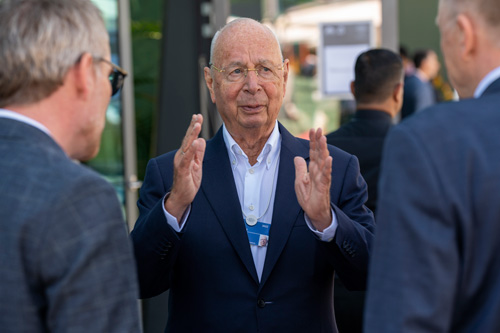
In my recently published book, The Competitive Enterprise in the Intelligent Age, I argue that technological transformation demands a radical rethinking of organisational concepts. Yet confronted with accelerating change and information overload, many leaders seek to preserve control by reinforcing industrial-era hierarchies with more reporting, committees and approval layers. They mistake procedural control for the capacity to respond. The tipping point comes when corporate functions such as human resources, finance and governance dominate the organisational system instead of serving and enabling its value-creating functions. Rigidity then cultivates mediocrity: conformity becomes safer than initiative, challenging assumptions becomes a career risk, and advancement favours those who protect the system rather than improve it. Capable people lower their ambitions or leave. Excellence gives way to satisfying the process. Mediocrity becomes a characteristic of the system, not a reflection of the talent within it. The result is an organisation increasingly equipped to defend yesterday’s arrangements rather than meet tomorrow’s demands.
Technology, above all AI systems, must become the integrating backbone of the enterprise. This means more than adding tools to existing departments. It requires shared data infrastructure and connected systems linking strategy, knowledge, people, processes, customers and decisions. Such a backbone can turn fragmented information into shared intelligence, make expertise accessible across functions and support real-time decisions and continuous learning. By reducing the need to transmit information through successive management layers, it can make radical simplification possible. Even large global enterprises should strive for only three or four genuine hierarchical levels below the CEO. Fewer levels must mean clearer accountability, not less responsibility.
A company that merely adds AI tools for individual employees or selected functions, without reconsidering its whole organisational system, risks adding costs without securing enterprise-wide productivity gains. A well-designed AI backbone should improve decision-making while simplifying processes, eliminating duplication and enabling greater value creation without a corresponding increase in overheads.[1] Investment efforts should therefore be channelled into strengthening the enterprise’s intelligent system and developing new value propositions for customers that this technological revolution now makes possible. Recent company announcements show that even successful, growing businesses are reducing staffing levels and seeking to lower staff-related fixed costs.[2] The priority should be to expand capabilities and customer value, not automatically to increase headcount and permanent overheads.
But technology alone cannot hold an organisation together. Mission and values must provide the cohesion once supplied primarily by hierarchy. Mission must function as an operating system: it gives direction, while values establish the boundaries within which autonomy can flourish. The more flexible the organisation, the stronger its common purpose must be. This foundation allows work to move horizontally, through multidisciplinary teams assembled around missions, problems and outcomes. Functions should remain centres of expertise and professional standards, not fortresses defending territory. People and resources should be deployed where they can create the greatest value, rather than confined by departmental boundaries. Managers must become orchestrators, coaches and teachers, developing people and ensuring accountability rather than merely transmitting instructions.
Such an organisation must execute, learn and reinvent itself simultaneously. Learning belongs in daily work, not only in training programmes. Projects should generate reusable knowledge, failures should yield insight, and professionals should continually renew their capabilities. Above all, enterprises must resist the hubris of success: “We know best because we are so successful.” Past achievement can turn established assumptions into unquestionable truths and discourage learning from others. A genuine learning organisation must scrutinise its successes as rigorously as its failures. Intellectual humility is not the opposite of confidence; it is a condition for continued renewal.
Learning must also extend beyond corporate boundaries. No enterprise can generate internally all the knowledge it requires. Permanent participation in wider knowledge systems – connecting universities, researchers, technology companies, customers, suppliers, policymakers and leaders across industries and society – must become part of its learning infrastructure. This is not occasional networking. It is systematic engagement that challenges assumptions, reveals emerging developments and translates external knowledge into better decisions. The AI backbone should connect these insights with internal experience and make them accessible throughout the enterprise. Competitive advantage will depend not only on what a company knows, but on how effectively it learns from those who know what it does not.
Organisational design also shapes the people an enterprise attracts and the ambitions it rewards. The old model can become a refuge for those whose overriding objective is to find the most comfortable position within the hierarchy. Today’s competition requires people driven by a shared mission, guided by values and prepared to take responsibility, exercise initiative and keep learning. They seek opportunities to contribute, not merely positions to occupy. Attracting and retaining such people requires more than a compelling mission statement: it requires leaders who live the values and a culture that rewards contribution rather than conformity.
The answer to uncertainty is not a more elaborate bureaucracy. It is a stronger core of mission, values and accountability, combined with flexible teams, an integrated AI backbone and learning that reaches beyond the enterprise. The winners of the Intelligent Age will not merely add technology to yesterday’s organisation. They will redesign the organisation itself, protecting its purpose, not its inherited structures.
The Intelligent Age Newsletter - LinkedIn
The Power of Constructive Optimism

Constructive optimism is not a naive belief that everything will be fine. It is a disciplined, informed stance that combines realism about problems with confidence in our capacity to improve them. It starts from a clear-eyed assessment of the breakdowns we face; it does not sugarcoat. But it refuses to stop there. It asks, given these realities, what we can do, step by step, to move toward a better state. Constructive optimism recognizes that progress is neither linear nor guaranteed. Yet it insists that, with effort and cooperation, we can tilt the balance toward renewal. It is the opposite of both complacency and fatalism.
Constructive optimism means more than believing in a better future. It means taking responsibility for helping to build it.
Four principles have guided me throughout my life.
The first is: never lose energy on negative events or developments. They must be understood, lessons must be drawn and, where necessary, action must be taken. But energy is too valuable to be consumed by resentment or by looking backward. The best response to adversity is to transform it into renewed purpose.
The second is: never rest on what you have achieved. Past accomplishments may provide experience and confidence, but they should never become a place of comfort. Achievement creates responsibility. Every success should become the starting point for the next contribution.
The third is: always be guided by your values. Values matter most when they are tested. They must be defended when necessary, firmly and with integrity. But their defense should never become an end in itself. The purpose must remain to serve, to create and to move forward.
The fourth is: never give up. Persistence is essential when principles, responsibilities or long-term objectives are at stake. But persistence must not turn into bitterness or fixation on the past. It must remain connected to hope, purpose and the determination to construct something better.
For me, this is also the essence of public service. Leadership is not ultimately measured by position, recognition or personal success, but by the contribution one makes to society and to future generations.
We are entering an Intelligent Age of extraordinary opportunity and profound responsibility. The task is not merely to anticipate the future, but to construct it consciously and responsibly.
After more than five decades devoted to building institutions and platforms for cooperation, I remain convinced that progress comes from combining vision with responsibility, experience with renewal, persistence with openness, and optimism with action.
Constructive optimism means constructing the future.
It means not allowing yesterday to consume the energy needed for tomorrow. It means remaining faithful to one's values, never giving up when they matter, and never allowing adversity to destroy the optimism needed to move forward.
To continue to create, to serve and to build - that is the power of constructive optimism.
The Intelligent Age Newsletter - LinkedIn
Farewell to the Global Shapers Community
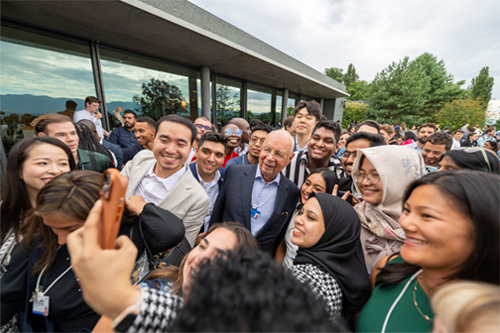
As I reflect now, in my 88th year of life, four principles stand out—principles that have guided my own journey, and which I want to share with you, hoping that they may guide your own path.
FIRST PRINCIPLE – LEADERSHIP MUST BE COHESIVE.
Leadership is not a single skill or position. It requires soul (purpose), brain (systemic thinking), heart (empathy), muscles (the ability to act), and nerves (resilience). Think about leadership as a whole. Cultivate your soul, your brain, your heart, your muscles, and your nerves if you truly want to make a difference.
SECOND PRINCIPLE – MEASURE YOUR LIFE BY WHAT YOU GIVE.
I have often been asked why I created foundations and communities rather than businesses. My answer is simple: I wanted to give more to others and to society than I took from it. If you see your life as a balance sheet, aim to leave it with a positive contribution to others. Whereas in business this would be called a loss, in life it defines your legacy.
THIRD PRINCIPLE – DO NOT LOSE TIME WITH NEGATIVITY.
As my career progressed and success grew, I encountered increasing criticism, resistance—and at times animosity. These experiences taught me that negativity is unavoidable if you try to make a difference. They also taught me not to waste energy on it. Negativity drains strength without creating progress. Focus on building what you believe is right.
FOURTH PRINCIPLE – PRACTICE CONSTRUCTIVE OPTIMISM.
Many people ask me what has kept me young. My answer is constructive optimism. The belief that improvement is possible—and worth working for—keeps curiosity alive, gives energy meaning, and makes setbacks bearable. Optimism, combined with responsibility, is a powerful force.
You are not shaping a distant future—you are shaping the present. When I see your commitment, seriousness, and sense of responsibility, I know that the community we built together is in good hands.
I step aside with gratitude for what you have already achieved, and with sincere confidence in what you will still accomplish.
With my very best wishes for your personal journeys and your continued service to society,
Klaus Schwab
Founder, Global Shapers Foundation
The Global Shapers Community, founded by Klaus Schwab, is a worldwide network of more than 10,000 young leaders active in over 500 cities. It empowers people under 30 to shape their communities through concrete, values-driven action. Non-partisan and impact-oriented, the community connects local initiatives with a strong global sense of responsibility.